
Energy Advice for B&B Owners Part 4 (Electricity)
Electricity
We all use it. You can’t see it. But you know its there, especially if you touch a live brown or red wire!
So how do the power companies arrive at your bill? First you’ll need to understand a little of their jargon.
What is a Kilowatt-Hour?
As you
will be billed in kilowatt-hours you might like to know that a
Kilowatt Hour
is the amount of electricity required to light one 1000W light bulb for 1 hour
or 2 500W light bulbs for I hour or …. You get the picture
Its one kilowatt of energy used for one hour, hence kilowatt-hour.
Climate Change Levy
Climate Change Levy or CCL is a Government tax on power usage designed to fund methods of negating some of the climate change issues we face. By purchasing your electricity from renewable source you can eliminate any CCL payment on your bill. If you are charged it will be at .0043 pence per kilowatt-hour which is Government determined, not you electricity supplier.
Meter Number
A unique number shown of you meter, which
identifies that device.
Account Number
Given to you by your supplier, which identifies you as the account holder.
Mpan Number
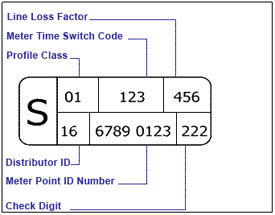
An MPAN (Meter Point Administration Number) is a unique number to your property. It is found on the electricity bill issued by your supplier. This is sometimes called a Supply Number but don’t confuse it with your customer reference/account number
The full MPAN is 21 digits long and appears like:
Without going into too much detail:
Profile Class
Every property has a profile class. If you are a domestic customer you are interested in two classes 01 and 02. Other classes that exist are 03, 04, 05, 06, 07, and 08. Where half-hourly metering is installed (large consumers) the profile class in 00.
Meter Time Switch Code (MTC)
The Meter Time Switch Code indicates how many dials your electricity meter has and what times they will operate during the day. The Meter Time Switch Code will show if your meter has two registers, one that records day consumption, the other night.
Line Loss Factor (LLF)
The Line Loss Factor code stipulates the expected costs the distribution company will charge the supplier for using the cables and network in your region. This Line Loss Factor code will also indicate to the electricity supplier the potential charges incurred, due to loss of energy incurred whilst getting the electricity supplier to your meter.
Distributor ID
The Distributor ID will identify the local Distribution Company for your electricity supply a bit like a bank sort code. The distribution company is responsible for management of the distribution system and electricity wires, which transports the electricity to your meter.
- 10 - Eastern Electricity
- 11 - East Midlands Electricity
- 12 - London Electricity
- 13 - MANWEB
- 14 - Midlands Electricity
- 15 - Northern Electricity
- 16 - NORWEB
- 17 - Scottish Hydro-Electric
- 18 - Scottish Power
- 19 - Seeboard
- 20 - Southern Electricity
- 21 - SWALEC
- 22 - SWEB
- 23 - Yorkshire Electricity
Meter Point ID Number
This is a unique number within the distribution area to identify the actual metering point.
Check Digit
This number is calculated from the Distributor ID and Meter Point ID Number to provide a check digit that other systems can use to validate the both numbers.
All the information above then is what your power company needs to produce you bill and make sure it gets to the right person.
The mathematical formula used to compute your bill is relatively simple:
CURRENT READ minus PREVIOUS READ multiplied by PRICE PER KILOWATT-HOUR (for how ever many unit prices you have) add CCL (at .0043 pence per kilowatt-hour if you pay CCL) add any STANDING CHARGE/S add VAT (5% for domestic customers or 17.5% for business customers) equals TOTAL BILL
Or to
put it another way: try the spreadsheet below:
| Electricity Usage and Billing Calculator | ||||||||||
| Tariff 1 | Price per KWH | Total £p | ||||||||
| Previous Read | ||||||||||
| Current Read | ||||||||||
| Consumption in KWH | £ | 1st Tariff Charge | ||||||||
| Tariff 2 | ||||||||||
| Previous Read | ||||||||||
| Current Read | ||||||||||
| Consumption in KWH | £ | 2nd Tariff Charge | (If you have one) | |||||||
| Tarif 3 | ||||||||||
| Previous Read | ||||||||||
| Current Read | ||||||||||
| Consumption in KWH | £ | 3rd Tariff Charge (if you have one) | ||||||||
| Total Kilowatt-Hours used | ||||||||||
| during this period | ||||||||||
| Add Climate Change Levy @ | £ | |||||||||
| (If you don't pay CCL enter zero above) | ||||||||||
| Add Standing Charge 1 | £ | Quarterly Standing Charge | ||||||||
| Add Standing Charge 2 | £ | Quarterly Standing Charge (if you have two) | ||||||||
| TOTAL | £ | Total Bill before VAT is added | ||||||||
| Add VAT Domestic at | 5% | £ | Total Bill Paying Domestic VAT | |||||||
| Add VAT Business at | 17.50% | £ | Total Bill Paying Standard VAT | |||||||
